How AI Personal Trainers Are Changing Fitness
Introduction
The convergence of artificial intelligence (AI) and fitness has moved well beyond step counters and calorie calculators. Today’s AI‑powered personal trainers deliver adaptive workout plans, real‑time feedback and personalized nutrition guidance at a fraction of the cost of traditional coaching. This shift is reshaping the global fitness industry and opening access to quality training for people who might never have hired a trainer. At the same time, research shows that human expertise, empathy and motivation remain critical. In this article, we examine how AI personal trainers work, review market trends, explore the benefits and limitations of AI coaching, and highlight how platforms like Champions Round the flagship fitness product developed by Red Meridian are setting the standard for adaptive, results‑driven training.
How AI personal trainers work
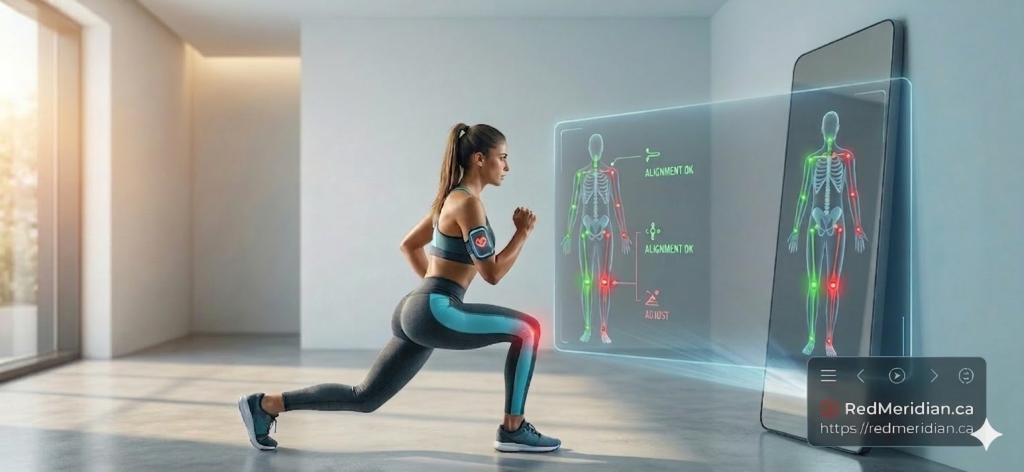
AI personal trainers are mobile and web applications that use machine learning algorithms, computer vision and large datasets to tailor workouts to an individual’s goals and capabilities. Unlike static exercise programs, these systems continually analyze your performance, recovery and feedback to adjust training intensity and movement selection. Computer vision allows some apps to track your body position in real time by estimating joint angles from a phone or webcam; this technology has achieved around 92% form detection accuracy, in line with the judgment of professional coaches. After each session your rated by perceived exertion or reps. The AI updates your plan accordingly, and adds progressive overload intensity while avoiding overtraining in the user.
The rapid adoption of these tools reflects both technological advances and economic realities. The AI personal trainer market, valued at about $16.86 billion in 2025, is projected to reach US $48.79 billion by 2032, representing an annual growth rate of 16.3%. AI coaching services typically cost $10–30 per month only 5–10 % of the price of a personal trainer session which makes them accessible to a much broader audience. For self motivated individuals, studies suggest AI coaches are 80–90% as effective as human trainers. However, combining AI with human oversight yields the best results: a Stanford Michigan study tracking 65,000 users found that hybrid AI‑human coaching delivered 74% greater weight‑loss results than AI alone.
Market trends and consumer attitudes
The broader fitness technology market is expanding quickly. Analyst projections from Research And Markets indicate that the global fitness app market will grow from US $10.6 billion in 2024 to US $33.6 billion by 2033, driven by AI‑powered personalization, wearables integration and social features. Smartphone adoption and the popularity of wearable devices mean more people are monitoring sleep, heart rate, nutrition and activity data in real time. Specialized apps are emerging such as running coaches, injury specific training and holistic wellness platforms and VC investors are pouring millions of dollars into AI fitness startups.
Despite the hype, real coaches still matter. Athletech News notes that only 10% of global consumers prefer AI workout guidance over human coaching, and an ISSA survey found that about 64% of fitness professionals believe AI will increase the value of being a certified trainer. This underscores a key point: AI tools excel at programming and convenience, but real trainers provide emotional support, nuanced form correction and accountability. Experience Life magazine echoes this sentiment, explaining that AI fitness apps can log workouts, personalize programs and remind users to rest, yet they can’t replace the motivation and empathy of a real trainer. Even when apps offer real time feedback akin to a “personal trainer in your pocket” they cannot read facial expressions or adapt to your mood like a real person can.
Benefits of AI coaching
AI personal trainers offer significant advantages for both clients and coaches:
Improved adherence and results
Studies reviewed by Forge’s AI research team show that AI‑guided workouts boost adherence by 40% compared to self‑directed training. Chatbot‑based programs increase exercise frequency, with 71% of users exercising more regularly. Hybrid AI‑human coaching delivers 74% better weight‑loss outcomes than AI‑only approaches. Another review notes that AI‑assisted rehabilitation methods can reduce recovery time by 30% and lower injury rates by 25% through improved form and workload management.
Efficiency and scalability
AI tools allow trainers to handle 30% more clients without sacrificing quality and lead to 20% higher client engagement. Trainers can focus on motivation, coaching cues and relationship building while the AI manages programming and data analysis. For consumers, on‑demand access and flexible pricing make high‑quality training more accessible. The virtual fitness market is growing by 32.7%, reflecting strong demand for digital training that fits busy lifestyles.
Real‑time feedback and injury prevention
Computer vision powered apps like SHRED can estimate joint angles with high precision and provide cues to correct posture. Research indicates that AI can detect form errors with 92% accuracy, compare your movements to ideal patterns and count repetitions reliably. Predictive models even achieve 85% accuracy in forecasting hamstring injuries. These capabilities help users avoid common mistakes and maintain proper technique, especially when training alone.
Cost and accessibility
With subscription pricing between $10 and $30 per month, AI personal trainers cost far less than the $50–$150 per session typically charged by trainers. This democratizes access to personalized coaching for students, busy professionals and anyone on a budget. For gym operators, offering AI‑enhanced training can generate new revenue streams while freeing staff to focus on high touch services.
Limitations and ethical considerations
AI personal trainers are not without drawbacks. Wearable data can be inconsistent; researchers have observed discrepancies between different devices measuring heart‑rate variability, sleep and other metrics. AI systems may also perpetuate biases if trained on non‑diverse datasets, potentially under estimating injury risk or over prescribing certain exercises. Privacy is another concern: many AI fitness apps collect large volumes of health data, and users may not fully understand how that information is stored or shared.
Most importantly, AI cannot replicate human empathy and contextual decision making. Personal trainers provide encouragement, adapt on the fly and watch for subtle cues like grimaces or fatigue. Experience Life notes that trainers motivate and inspire, bringing an energy that AI tools cannot emulate. Fitness industry experts therefore recommend a hybrid approach, using AI for programming and analytics while maintaining human oversight for motivation, form correction and injury management.
Champions Round: A case study
One of the most innovative AI personal training platforms on the market is Champions Round, developed by Red Meridian. Champions Round offers adaptive high‑intensity interval training (HIIT) sessions tailored to your goals, injuries and available equipment. The platform’s AI coach, Jessika Lopez, starts by asking about problem areas such as knee pain or time constraints and then modifies each session accordingly. Each workout consists of 10 round circuits that adjust difficulty in real time, ensuring you’re challenged without risking injury. Users can track their weight, streaks and achievements quietly, focusing on progress rather than social metrics. It also provides macro optimized nutrition plans, recommending protein, carbohydrate and fat targets based on your body composition and goals. Progress tracking and weekly check‑ins help you stay accountable, and a self‑improving plan engine continually updates your program as you gain strength and endurance.
The product emphasizes adaptation Jessika “gets you” by incorporating injury substitutions and life event adjustments. This adaptability sets Champion’s Round apart from generic workout apps, offering something closer to a real coach experience. As part of Red Meridian’s suite of AI‑powered products, Champions Round integrates seamlessly with the company’s automation platforms, enabling businesses to provide personalized wellness programs alongside lead capture, customer support and scheduling tools. To explore the platform or sign up for a free trial, visit Red Meridian’s product page at(https://championsround.io).
What this means for trainers and studios
The rise of AI personal trainers doesn’t spell the end of human coaching it changes how trainers deliver value. Certified professionals who embrace AI can expand their reach, offer more personalized programs and spend more time on motivation and form correction. In fact, 64% of trainers believe AI will enhance the value of human certifications, and the U.S. Bureau of Labor Statistics projects 12% growth in fitness trainer jobs through 2034. Gyms and studios can offer tiered membership levels that pair app‑based programming with in person coaching, capturing new revenue without increasing overhead.
For entrepreneurs, the booming market represents an opportunity to build specialized AI training products. Whether focusing on endurance sports, pre and post natal fitness, rehabilitation or corporate wellness, AI systems can deliver customized plans at scale. The key is to maintain a human touch using AI to enhance, not replace, the trainer client relationship.
Conclusion
AI personal trainers are reshaping the fitness landscape by making high‑quality, customized coaching accessible to millions of people. They offer real time feedback, adaptive programming and affordable pricing that human trainers alone cannot match. Yet the most effective approach remains a hybrid model that combines AI’s data driven insights with human empathy and expertise. Platforms like Champion’s Round illustrate how AI can augment rather than supplement personal training, delivering adaptive HIIT sessions, nutrition guidance and continuous progress tracking. As the market grows and technology advances, trainers, gyms and clients who leverage these tools thoughtfully will be best positioned to achieve sustainable health and fitness goals. To learn more about Champions Round or to start a free trial, see the product page link in the references below.
AI is already changing the way people train. Instead of manually planning workouts and nutrition, you can let AI handle the process.
I built ChampionsRound, an AI-powered platform that generates workouts, structures your nutrition, and tracks your progress automatically.
Start training with AI
https://redmeridian.ca/products
Further Reading and References
1. Athletech News, “In the Age of AI, Human Personal Trainers Might Become a Luxury”
1. Athletech News, “Fitness App Market Gets $33B Projection, Driven by AI Personalization”
1. Experience Life, “How AI Is Changing Health and Fitness”
1. Forge AI Trainer, “Can AI Replace a Personal Trainer? What the Research Says”
1. AionX, “Best AI Fitness Trainers: Top Apps Compared for Results”
1. Create.fit, “13 Must‑Know AI Personal Training Statistics: What Trainers Need in 2025”
1. Champion’s Round – Daily HIIT Workouts
1. Red Meridian, Adaptive AI Fitness Platform
